Industry characteristics
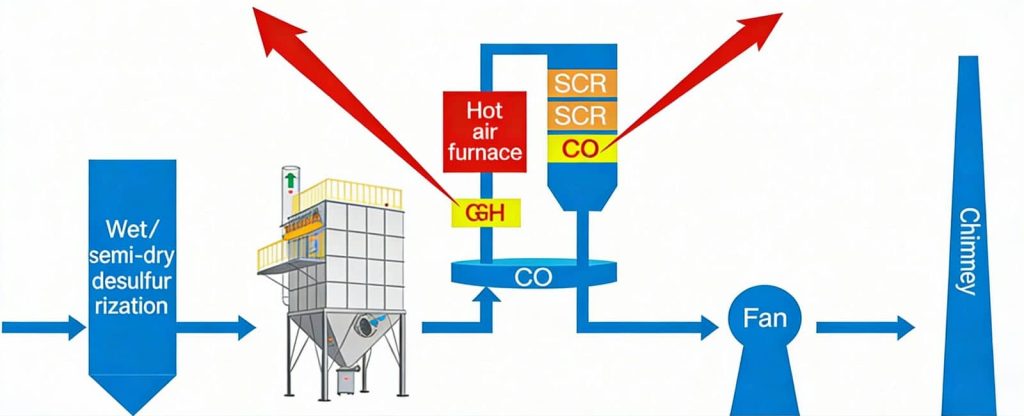
Option 1
-
Advantages: Catalytic oxidation is exothermic and allows direct heating, resulting in high thermal efficiency. Before ammonia injection, there is no secondary pollution caused by ammonia oxidation, and the process is not affected by ammonium sulfate.
-
Disadvantages: Requires an additional reactor, leading to high investment costs and long, complex retrofitting.
-
Applicable: Suitable for new projects or SCR systems without a spare bed layer.
Option 2
Advantages: Catalytic oxidation is exothermic, with heating via a heat exchanger. There is some heat loss, but existing denitration reactors can be utilized, achieving high space efficiency, low investment cost, and easier retrofitting.
Disadvantages: Ammonia after denitration may undergo secondary oxidation, and ammonium sulfate effects remain.
Applicable: Suitable for limited-space sites or SCR systems with a spare bed layer.
Benefits Case Studies
Taking a 360 m² sintering machine as an example, with a standard flue gas flow rate of 1.44×10⁶ Nm³/h, the denitrification process consumes approximately 20,000 m³/h of blast furnace gas. Based on an annual operating time of 8,000 hours, an original flue gas CO concentration of 6,000 mg/Nm³, and a CO removal efficiency of 60%, the benefits are as follows:

12,800 tons/year | 16.8–19.2 million yuan/year | 33,536 tons/year
- The amount of blast furnace gas saved is equivalent to 12,800 tons of standard coal per year.
- This translates to an annual power generation benefit of 16.8–19.2 million yuan.
- It also corresponds to an annual carbon dioxide emission reduction of 33,536 tons.