Choosing the right filter bag material is critical for achieving efficient dust collection, longer service life, and lower operational costs. In industrial environments such as cement plants, power plants, and chemical processing facilities, the wrong material can lead to frequent replacements, system failures, and even production downtime.
1. Types of Filter Bag Materials
Choosing the right material for your filter bag is critical. Each material has distinct characteristics, and selecting the optimal one ensures superior filtration, longer service life, and reduced operational costs.
1.1 Polypropylene (PP)
For industries like water treatment, food & beverage, and liquid processing, polypropylene (PP) filter bags are a reliable choice for removing suspended solids, adhesive residues, and micro-impurities. Made from 100% polypropylene, they meet FDA food-grade standards and deliver safe, efficient filtration.
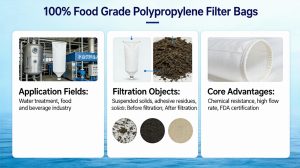
PP filter bags offer excellent chemical resistance, handling acids, bases, oils, and organic solvents, while supporting high flow rates of 20–40 m³/h for efficient processing.
Advantages
- Chemical Stability: Maintains integrity in acidic or alkaline solutions.
- Hydrophobic: Resistant to moisture swelling, suitable for high-humidity environments.
- High Purity: Silicon-free, environmentally friendly, reduces contamination risks.
- Consistent Performance: Thermal-welded design ensures tight sealing and >99.9% filtration efficiency.
- Food-Safe: Non-toxic, FDA-compliant for beverages, potable water, and food processing.
Limitations
- Temperature Limit: Max 107°C, unsuitable for high-temperature processes.
- Limited Chemical Resistance: Not ideal for extremely aggressive or oxidizing solutions.
- Mechanical Wear: Less durable with abrasive or sharp particles, requiring more frequent replacement.
- Colored Substances: May struggle to filter intensely pigmented or concentrated liquids.
1.2 Polyester (PET)
The Durable Workhorse for Dry Environments
Polyester filter bags are engineered for mechanical strength and abrasion resistance. The fibers are entangled via needle-punching and often undergo calendaring (heat-setting) to create a smooth surface that aids in dust release. It is the preferred material for pulse-jet dust collectors.
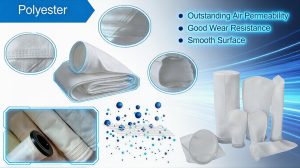
Key Attributes: Excellent abrasion resistance; high tensile strength; stable up to 275°F (135°C); resistant to most organic acids and solvents.
Limitations: Hydrolyzes (chemically breaks down) in high-humidity or wet conditions; poor resistance to strong alkalis.
Best For: Cement plants, mining operations, pharmaceutical powder handling, and woodworking dust collection—applications where the gas stream is dry and abrasive.
1.3 Nylon (Polyamide)
The Reusable Mesh for High Flow
Unlike felted materials, Nylon filter bags are usually constructed from monofilament or multifilament mesh. This structure provides a rigid, non-fibrous shedding surface, making them ideal for capturing large particles without clogging.
Key Attributes: High melting point (up to 320°F / 160°C); exceptional tensile strength; easily cleaned and reusable; precise pore sizes (mesh count).
Limitations: Susceptible to hydrolysis and microbial attack; limited to coarse filtration (typically >10 microns); poor resistance to mineral acids.
Best For: Paint and coating filtration, electroplating solutions, pre-filtration for reverse osmosis, and industrial water where high flow rates are required.
1.4 Stainless Steel (SS 304/316L)
The Ultimate in Durability
For extreme conditions where polymers fail, stainless steel mesh filter bags are the solution. These are rigid, woven metal meshes welded into a bag shape. They offer zero media migration and are fully cleanable.
Key Attributes: Extreme temperature tolerance (up to 900°F / 480°C); universal chemical compatibility (except chlorides for 304); high mechanical strength; autoclaveable and reusable.
Limitations: High initial cost; limited to screen filtration (surface filtration); heavy weight requires robust housing support.
Best For: High-temperature polymer melts, aggressive chemical processing, steam filtration, and applications requiring absolute cleanliness and sterilization.
1.5 Polytetrafluoroethylene (PTFE)
The High-Performance Specialist
PTFE is the gold standard for demanding air pollution control. Often used as a membrane laminated onto a scrim (support fabric), PTFE offers near-zero friction and exceptional chemical inertness. It is the go-to material for incinerators and hazardous waste treatment.
Key Attributes: Outstanding resistance to all chemicals (acids, bases, solvents) and oxidation; continuous service up to 500°F (260°C); hydrophobic and oleophobic.
Limitations: High cost; relatively low abrasion resistance; requires careful installation to avoid damage.
Best For: Hazardous waste incineration, coal-fired boilers, asphalt plants, and titanium dioxide production where sticky, corrosive, or high-temperature dusts are present.
1.6 Polyphenylene Sulfide (PPS)
The Thermal-Chemical Hybrid
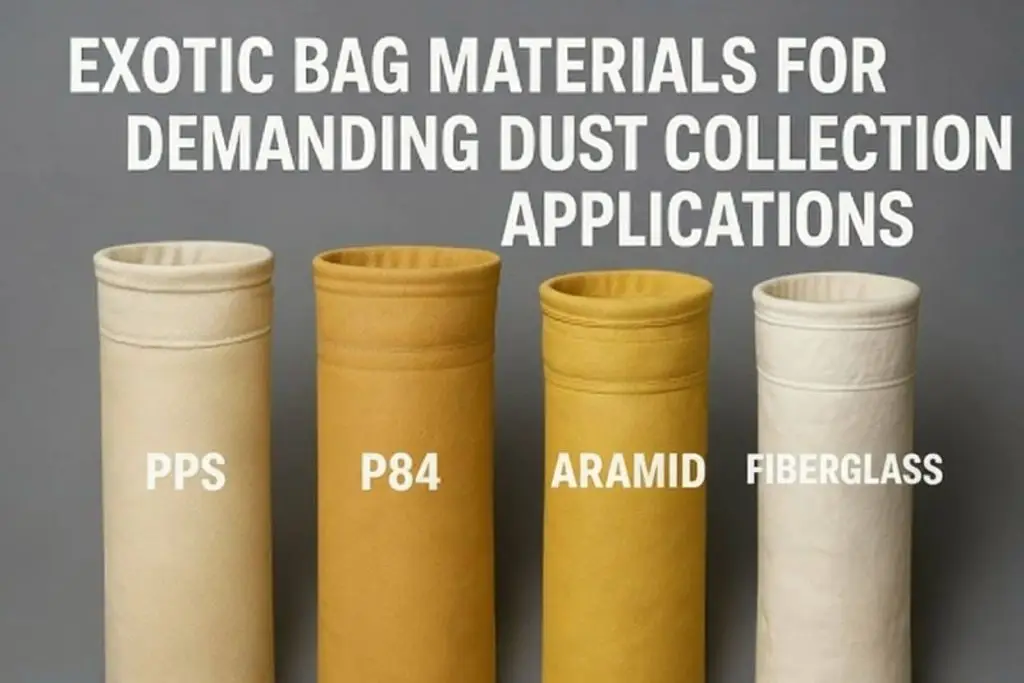
Known commercially as Ryton, PPS fibers offer a balance between high-temperature resistance and chemical tolerance. It is specifically designed to handle the sulfur oxides and moisture found in coal-fired boiler exhaust.
Key Attributes: Excellent resistance to acids, alkalis, and hydrolysis; continuous operation at 375°F (190°C); inherently flame-retardant.
Limitations: Vulnerable to oxidation (NOx); can be degraded by high concentrations of oxidizing chemicals; moderate cost.
Best For: Coal-fired power plants, waste-to-energy facilities, and industrial boilers where the gas contains high levels of SOx and moisture.
1.7 Fiberglass
The High-Temperature Solution
Fiberglass bags are constructed from inorganic glass fibers. They offer dimensional stability and high tensile strength at temperatures that would melt synthetic polymers. However, they are brittle and require careful handling.
Key Attributes: Superior high-temperature resistance (up to 550°F / 288°C); excellent dimensional stability; resistant to most acids (except HF) and oxidizing agents.
Limitations: Low abrasion resistance; brittle; requires chemical treatment (silicone/finishes) for flexibility; sensitive to alkali attack.
Best For: Carbon black manufacturing, steel mill off-gas, cement kilns, and asphalt plants where extreme heat is the primary challenge.
1.8 Aramid (Meta-Aramid)
The Industry Standard for Heat
Aramid fibers, such as Nomex®, are synthetic aromatic polyamids known for their excellent thermal stability and mechanical toughness. They are a cost-effective alternative to PTFE for high-temperature dust collection.
Key Attributes: Continuous operation at 400°F (204°C); excellent abrasion and flex resistance; resistant to organic solvents.
Limitations: Sensitive to moisture and high pH (alkalis); susceptible to degradation from sulfuric acid condensation.
Best For: Asphalt mixing plants, foundries, non-ferrous metal smelting, and cement clinker coolers.
1.9 Cotton
The Natural Option
While largely replaced by synthetics in heavy industry, cotton remains relevant for specific niche applications. It is a natural, biodegradable fiber that offers high dust-holding capacity for large, non-abrasive particles.
Key Attributes: High permeability; good static dissipation (if untreated); low cost; resistant to mild alkalis.
Limitations: Low temperature limit (180°F / 82°C); combustible; absorbs moisture; poor resistance to acids and mold.
Best For: Food processing (dry powders like flour), pharmaceutical dust collection, and woodworking where static discharge is a concern.
2. Industry Applications: Matching Material to Mission
Understanding the material is only half the battle. The real expertise lies in matching that material to the specific operational conditions of your industry.
The Metal Industry (Smelting & Casting)
The Challenge: High temperatures (often >400°F), abrasive dust, and corrosive off-gases like zinc oxide or sulfur dioxide.
The Solution: Fiberglass (for primary heat resistance) or Aramid (for abrasion resistance). For processes involving sticky fumes, PTFE membranes prevent blinding.
Key Requirement: Thermal stability and oxidation resistance.
The Cement Industry
The Challenge: Highly abrasive dust, high moisture (in raw mills), and varying temperatures. Electrostatic charges can also cause dust adhesion.
The Solution: Polyester (for raw mills and coolers where anti-static properties are needed). Aramid or PPS for kiln and clinker cooler applications where temperatures hover around 350°F.
Key Requirement: High abrasion resistance and mechanical strength.
Chemical & Pharmaceutical Processing
The Challenge: Exposure to aggressive solvents, acids, and bases; need for absolute purity; stringent FDA/GMP compliance.
The Solution: Polypropylene (PP) for general chemical compatibility in liquids. PTFE for aggressive chemical vapors or high-purity air. Nylon for solvent-based paints and coatings.
Key Requirement: Chemical inertness and regulatory compliance (FDA, USP Class VI).
Power Generation (Coal & Biomass)
The Challenge: Flue gas containing high levels of SOx, NOx, and moisture. Temperatures vary but often fall into the “acid dew point” range where condensation occurs.
The Solution: PPS (Ryton) is the industry standard for coal-fired boilers due to its hydrolysis resistance and acid tolerance. PTFE is used for high-oxygen or waste-to-energy plants.
Key Requirement: Hydrolysis resistance and acid resistance.
Food & Beverage
The Challenge: Preventing contamination, handling high-viscosity fluids (syrups, oils, juices), and meeting sanitation standards.
The Solution: Polypropylene and Nylon mesh bags are preferred. They must be manufactured in cleanrooms and often sterilized via gamma radiation.
Key Requirement: FDA compliance and non-shedding construction.
3. Critical Selection Criteria: Beyond the Material Name
To ensure you don’t just buy a filter bag, but the right filter bag, evaluate your process based on these three critical pillars.
3.1 Thermal Limits (Temperature)
Temperature is the primary killer of filter bags.
Low Temperature (<200°F / 93°C): Polypropylene and Cotton are viable.
Medium Temperature (200°F – 350°F / 93°C – 177°C): Polyester (dry only) and Aramid operate here.
High Temperature (>350°F / 177°C): PTFE, Fiberglass, and Stainless Steel are required.
The Risk: Exceeding the continuous operating temperature (COT) causes melting (for synthetics) or catalytic oxidation, leading to brittleness and catastrophic failure.
3.2 Chemical Environment & Moisture
The interaction between the gas/liquid and the fiber chemistry dictates longevity.
Acidic Conditions: PTFE, PPS, and Polypropylene are highly resistant. Polyester and Aramid degrade in strong acids.
Alkaline (Basic) Conditions: PTFE and Polypropylene are safe. Aramid and Polyester are vulnerable.
Hydrolysis (Moisture + Heat): This is a common failure mode. If your process involves high heat and moisture, Polyester is a poor choice. PPS, PTFE, and Fiberglass are required for “wet” heat applications.
3.3 Economic Lifecycle (Cost vs. Value)
The purchase price is just the beginning. Evaluate total cost of ownership (TCO).
Low Initial Cost: Polypropylene, Polyester, Cotton. Ideal for disposable applications with non-aggressive media.
High Durability / Reusable: Nylon and Stainless Steel. Higher upfront cost but offset by longevity and cleanability.
Performance Under Stress: PTFE and Aramid. The highest upfront cost, but they provide the longest service life in harsh conditions, reducing labor costs associated with frequent changeouts.
4. Conclusion: Making the Informed Choice
Selecting a filter bag material is a strategic decision that impacts operational efficiency, regulatory compliance, and maintenance budgets. The “best” bag is not the cheapest or the most expensive; it is the one that aligns precisely with your operating parameters.
For liquid clarity at low temperatures, Polypropylene offers unbeatable chemical resistance and value.
For dry, high-temperature dust collection, Aramid or Fiberglass provide the thermal backbone needed for stability.
For the harshest environments—where heat, acid, and moisture converge— PTFE stands as the ultimate solution.
For high-flow, coarse filtration requiring reusability, Nylon or Stainless Steel mesh bags are the optimal choice.
By evaluating the thermal, chemical, and mechanical demands of your application against the detailed properties outlined in this guide, you can ensure that your filtration system operates at peak efficiency, safeguarding your product quality and your bottom line.