
ガラス・セラミック窯向けSCR触媒ソリューション:分子イノベーションによるアルカリ金属中毒の克服
In the glass and ceramic manufacturing industries, achieving stable DeNOx performance is a persistent challenge. The primary culprit? Alkali and alkaline earth metal poisoning. These elements, inherent in the raw materials and melting processes, act as “chemical toxins” that can deactivate standard SCR catalysts within months.
ガラスおよびセラミック製造業界において、安定した脱硝(DeNOx)性能を達成することは永続的な課題です。その主な原因は何でしょうか?それは、アルカリ金属およびアルカリ土類金属による被毒です。原料や溶解プロセスに由来するこれらの元素は「化学的毒物」として作用し、標準的なSCR(選択的触媒還元)触媒をわずか数ヶ月で失活させてしまいます。
At Yuanchen Technology, we have moved beyond surface-level fixes. By integrating three core molecular-level technologies, we provide SCR catalysts specifically engineered to thrive in high-sodium and high-potassium environments.
元琛科技(Yuanchen Technology)は、表面的な応急処置にとどまらない対策を講じています。3つのコアとなる分子レベルの技術を統合することで、高ナトリウムおよび高カリウム環境下でも優れた性能を発揮するように特別に設計されたSCR触媒を提供します。
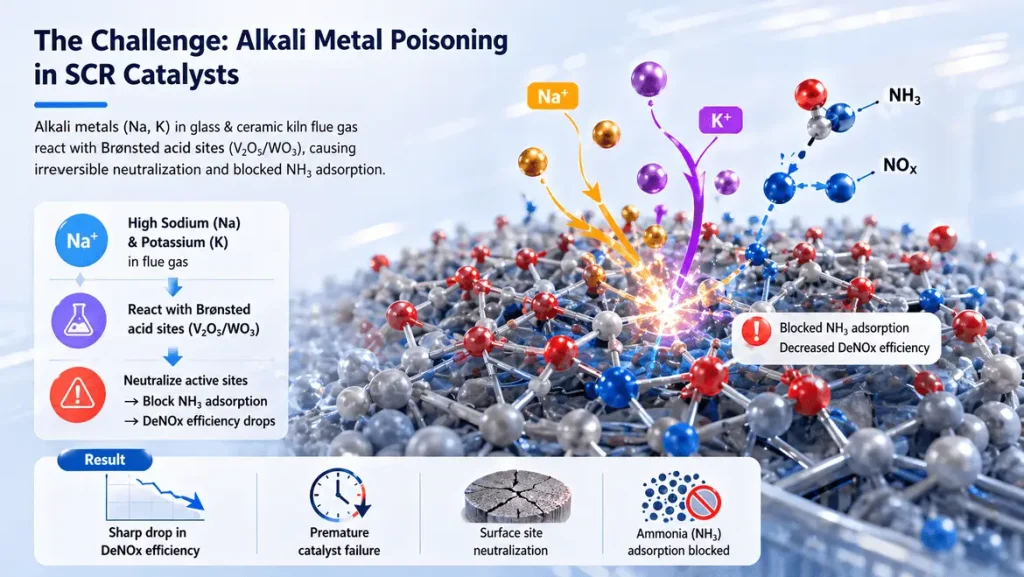
The Challenge: Why Does Deactivation Happen?
課題:なぜ失活が起こるのか?
Flue gas from glass kilns is rich in sodium ($Na$) and potassium ($K$). These metals react with the Brønsted acid sites ($V_2O_5/WO_3$) on the catalyst surface, causing irreversible chemical neutralization. This “poisoning” blocks ammonia adsorption, leading to a sharp drop in DeNOx efficiency and premature catalyst failure.
ガラス窯からの排ガスには、ナトリウム($Na$)やカリウム($K$)が豊富に含まれています。これらの金属が触媒表面のブレンステッド酸点($V_2O_5/WO_3$)と反応し、不可逆的な化学的中和を引き起こします。この「被毒」によってアンモニアの吸着が阻害され、脱硝効率の急激な低下と触媒の早期寿命を招くことになります。
Breakthrough: Yuanchen’s Triple-Defense Technology
画期的進歩:元琛科技のトリプルディフェンス技術
Our anti-poisoning SCR catalyst is built on three distinct technical pillars that protect the active sites from the atomic level up.
当社の耐被毒SCR触媒は、原子レベルから活性点を保護する3つの明確な技術的柱に基づいています。
Technology I: Enhancement of Carrier Acidity (Depth of Defense)
技術 I:担体酸性の強化(防御の深さ)
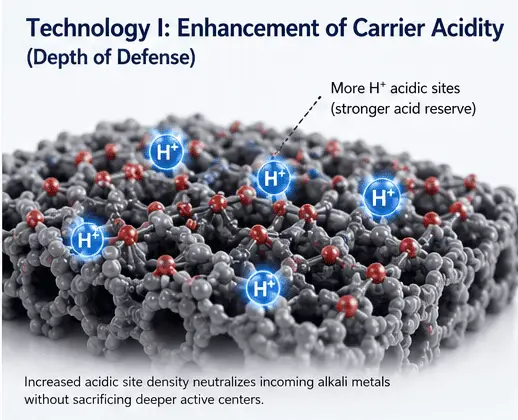
Standard catalysts often lack sufficient acidic sites to handle high alkali loads. We have re-engineered the Support (Carrier) to significantly increase the density of $H^+$ (Hydrogen ion) acidic sites.
- How it works: By increasing the “reserve” of acidic sites, the catalyst can sacrifice surface ions to neutralize incoming alkali metals without compromising the deeper active centers required for the DeNOx reaction.
標準的な触媒は、高いアルカリ負荷に対応するための十分な酸点を備えていないことがよくあります。当社は担体(キャリア)の設計を刷新し、$H^+$(水素イオン)酸点の密度を大幅に向上させました。
- メカニズム: 酸点の「リザーブ(蓄え)」を増やすことで、触媒は流入するアルカリ金属を中和するために表面イオンを犠牲に(身代わりに)することができます。これにより、脱硝反応に必要な深部の活性中心を損なうことなく維持します。
Technology II: Surface Active Site Multiplication (Efficiency Boost)
技術 II:表面活性点の増殖(効率の大幅向上)
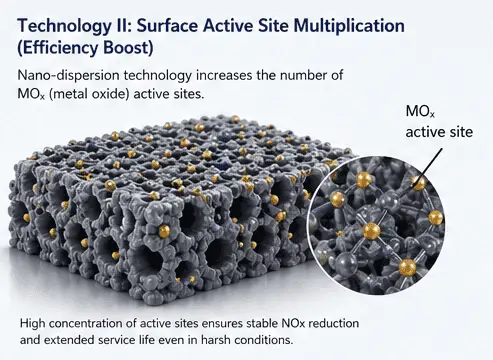
We utilize nano-dispersion technology to increase the number of $MO_x$ (Metal Oxide) active sites across the carrier surface.
- How it works: This ensures that even under heavy dust and alkali exposure, the catalyst maintains a high concentration of available reaction points, ensuring stable NOx reduction levels and extended service life.
当社はナノ分散技術を活用し、担体表面全体の$MO_x$(金属酸化物)活性点の数を増加させています。
- メカニズム: これにより、高ダストかつ高アルカリの過酷な環境にさらされても、触媒は利用可能な反応点を高濃度で維持できるため、安定したNOx還元レベルと長寿命化が保証されます。
Technology III: Electrostatic Repulsion & Coordination Fixation (The Core Innovation)
技術 III:静電反発と配位固定(コアとなる革新技術)
This is our most advanced “Black Tech” solution, creating a dynamic molecular barrier against toxins.
これは当社の最も先進的な「ブラックテック(革新技術)」ソリューションであり、毒物に対して動的な分子バリアを形成します。
1. Electrostatic Field Repulsion
1. 電界による静電反発
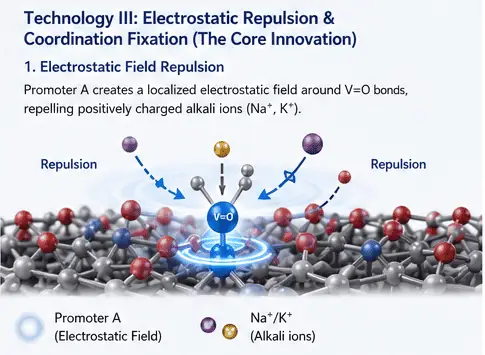
We incorporate specific Promoter A around the $V=O$ (Vanadium-Oxygen) active bonds to create a localized electrostatic field.
- The Mechanism: Since alkali ions like $K^+$ and $Na^+$ are positively charged, they are repelled by the co-directional charge of the field. Most toxins are deflected before they can even touch the catalyst’s core structure.
当社は、$V=O$(バナジウム-酸素)活性結合の周囲に特定の助触媒 Aを組み込むことで、局所的な静電界を生成させています。
- メカニズム: $K^+$や$Na^+$のようなアルカリイオンは正(プラス)に帯電しているため、電界の同方向の電荷によって反発されます。ほとんどの毒物は、触媒のコア構造に接触する前に偏向・排除されます。
2. Induced Migration & Coordination Fixation
2. 誘導移動と配位固定
For the few ions that penetrate the repulsion field, we have embedded “molecular traps” using Promoter B.
- The Mechanism: The metal ions ($Me^+$) are induced to migrate toward a specific Vanadium-like molecular structure, where they undergo Coordination Fixation (also known as Active Site Transfer). The toxin is permanently locked in a non-reactive zone, leaving the vital $V=O$ sites free to continue the DeNOx process.
反発電界をすり抜けてくるわずかなイオンに対しては、助触媒 Bを用いた「分子の罠(トラップ)」を埋め込んでいます。
- メカニズム: 金属イオン($Me^+$)は特定のバナジウム類似の分子構造へと誘導されて移動し、そこで配位固定(活性点転移としても知られる)を受けます。毒物は非反応ゾーンに永久にロックされるため、極めて重要な$V=O$活性点は解放された状態に保たれ、脱硝プロセスを継続することができます。
Technical Performance Matrix
技術性能マトリクス
Our specialized catalysts outperform standard variants in harsh industrial kiln environments:
当社の専門特化型触媒は、過酷な工業用窯の環境下において標準的な変種を凌駕する性能を発揮します。
| Feature | Standard SCR Catalyst | Yuanchen Anti-Poisoning Catalyst |
| Alkali Resistance ($Na/K$) | Low (Rapid Deactivation) | Extremely High (Molecular Shielding) |
| Activity Retention (3000h) | < 60% | ≥ 95% |
| NH₃ Slip Control | < 5 ppm | < 3 ppm |
| Service Life | 8,000 – 12,000 Hours | 24,000+ Hours |
| 特徴・項目 | 標準的なSCR触媒 | 元琛科技 耐被毒触媒 |
| 耐アルカリ性 ($Na/K$) | 低い(急速に失活) | 極めて高い(分子シールド) |
| 活性維持率 (3000h) | < 60% | ≥ 95% |
| NH₃スリップ制御 | < 5 ppm | < 3 ppm |
| 耐用寿命 | 8,000 – 12,000 時間 | 24,000+ 時間 |