
In the glass and ceramic manufacturing industries, achieving stable DeNOx performance is a persistent challenge. The primary culprit? Alkali and alkaline earth metal poisoning. These elements, inherent in the raw materials and melting processes, act as “chemical toxins” that can deactivate standard SCR catalysts within months.
At Yuanchen Technology, we have moved beyond surface-level fixes. By integrating three core molecular-level technologies, we provide SCR catalysts specifically engineered to thrive in high-sodium and high-potassium environments.
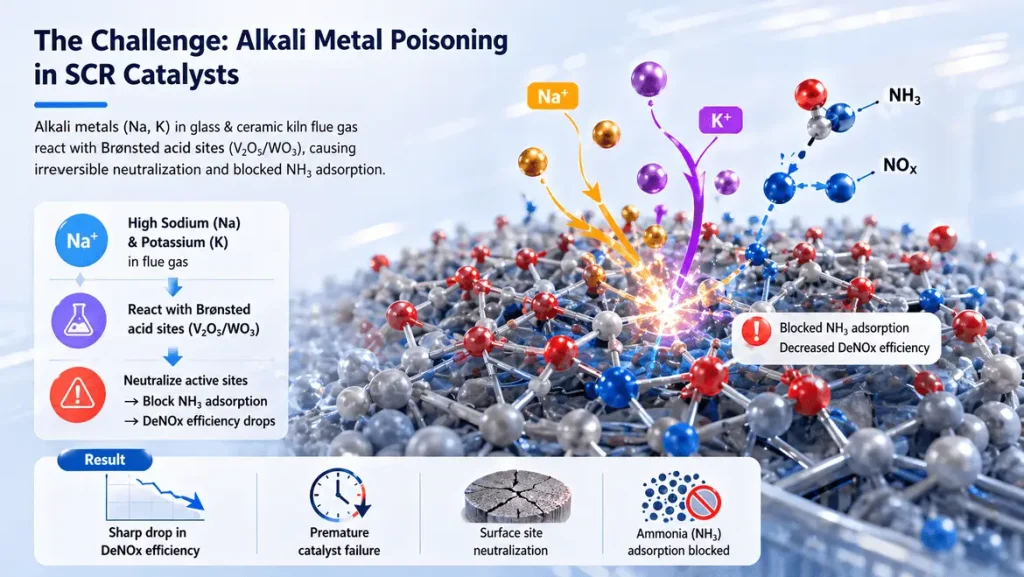
The Challenge: Why Does Deactivation Happen?
Flue gas from glass kilns is rich in sodium ($Na$) and potassium ($K$). These metals react with the Brønsted acid sites ($V_2O_5/WO_3$) on the catalyst surface, causing irreversible chemical neutralization. This “poisoning” blocks ammonia adsorption, leading to a sharp drop in DeNOx efficiency and premature catalyst failure.
Breakthrough: Yuanchen’s Triple-Defense Technology
Our anti-poisoning SCR catalyst is built on three distinct technical pillars that protect the active sites from the atomic level up.
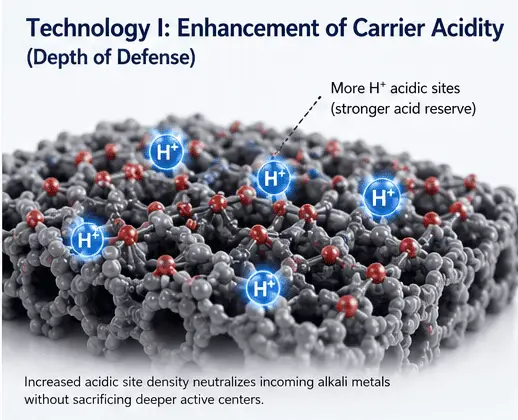
Technology I: Enhancement of Carrier Acidity (Depth of Defense)
Standard catalysts often lack sufficient acidic sites to handle high alkali loads. We have re-engineered the Support (Carrier) to significantly increase the density of $H^+$ (Hydrogen ion) acidic sites.
- How it works: By increasing the “reserve” of acidic sites, the catalyst can sacrifice surface ions to neutralize incoming alkali metals without compromising the deeper active centers required for the DeNOx reaction.
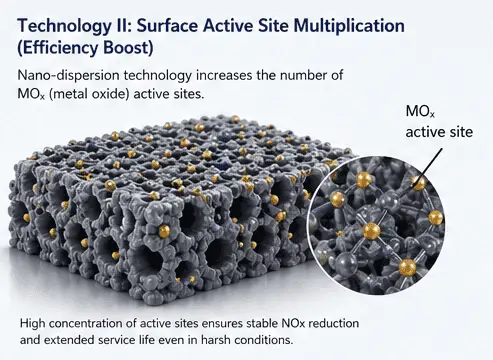
Technology II: Surface Active Site Multiplication (Efficiency Boost)
We utilize nano-dispersion technology to increase the number of $MO_x$ (Metal Oxide) active sites across the carrier surface.
- How it works: This ensures that even under heavy dust and alkali exposure, the catalyst maintains a high concentration of available reaction points, ensuring stable NOx reduction levels and extended service life.
Technology III: Electrostatic Repulsion & Coordination Fixation (The Core Innovation)
This is our most advanced “Black Tech” solution, creating a dynamic molecular barrier against toxins.
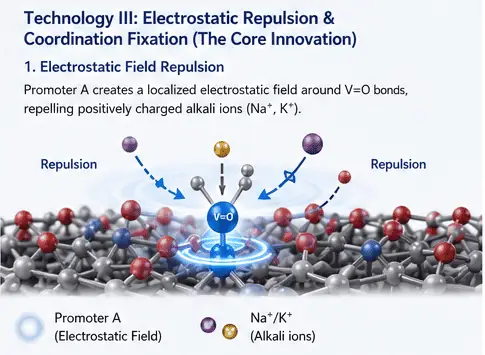
1. Electrostatic Field Repulsion
We incorporate specific Promoter A around the $V=O$ (Vanadium-Oxygen) active bonds to create a localized electrostatic field.
- The Mechanism: Since alkali ions like $K^+$ and $Na^+$ are positively charged, they are repelled by the co-directional charge of the field. Most toxins are deflected before they can even touch the catalyst’s core structure.
2. Induced Migration & Coordination Fixation
For the few ions that penetrate the repulsion field, we have embedded “molecular traps” using Promoter B.
- The Mechanism: The metal ions ($Me^+$) are induced to migrate toward a specific Vanadium-like molecular structure, where they undergo Coordination Fixation (also known as Active Site Transfer). The toxin is permanently locked in a non-reactive zone, leaving the vital $V=O$ sites free to continue the DeNOx process.
Technical Performance Matrix
Our specialized catalysts outperform standard variants in harsh industrial kiln environments:
| Feature | Standard SCR Catalyst | Yuanchen Anti-Poisoning Catalyst |
| Alkali Resistance ($Na/K$) | Low (Rapid Deactivation) | Extremely High (Molecular Shielding) |
| Activity Retention (3000h) | < 60% | ≥ 95% |
| NH₃ Slip Control | < 5 ppm | < 3 ppm |
| Service Life | 8,000 – 12,000 Hours | 24,000+ Hours |