
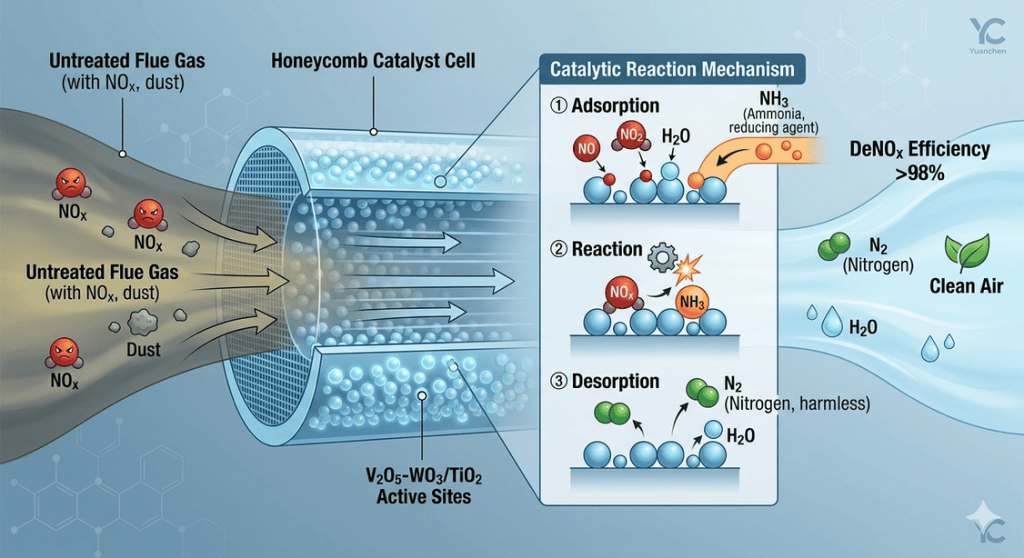
4NO + 4NH3 + O2 → 4N2 + 6H2O
2NO2 + 4NH3 + O2 → 3N2 + 6H2O
Professional APC Solution
High-Performance Honeycomb
SCR Catalyst
Providing stable nitrogen oxide removal (DeNOx) for extreme industrial environments. Tailored for power plants, steel mills, and cement kilns.
DeNOx Efficiency: ≥ 98.5%
Service Life: 24,000 - 32,000 Working Hours
Low SO2/SO3 Conversion Rate: ≤ 0.7%
Full-Temperature Working Windows
Whether it's ultra-low or extreme heat, our catalysts maintain high catalytic activity and structural integrity.
120°C - 150°C
Ultra-Low Temperature
Specialized for tail-end SCR. High surface acidity inhibits ABS (Ammonium Bisulfate) deposition, saving energy by avoiding flue gas reheating.
240°C - 420°C
Wide Temp Window
The versatile solution for thermal power and steel sintering. Optimized active site distribution for variable load operations.
450°C - 550°C
High Temperature
Incorporates thermal stabilizers to prevent sintering of the TiO2 carrier. Perfect for Gas Turbines and Waste Incineration.
SCR Reaction Mechanism
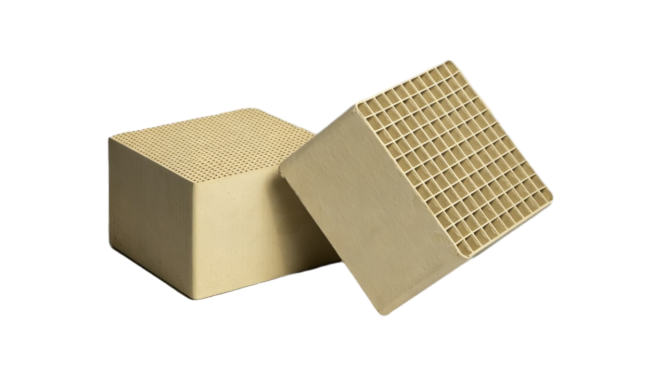
Selective Catalytic Reduction (SCR) technology uses NH3 as a reducing agent to convert NOx into N2 and H2O. Our honeycomb structure maximizes the contact area between the gas and the active sites.
Equipped with specialized vanadia-titania (V₂O₅-WO₃/TiO₂) technology, our product ensures low SO₂ to SO₃ conversion while maintaining high catalytic activity.
One Solution for Every Industry
Our catalysts are successfully deployed in diverse sectors globally.
Biomass Power
Thermal Power
Cement Kilns
Glass & Ceramics
Waste-to-Energy
Petrochemical
Coking Plants
Biomass Power
Technical FAQ
How to choose the right cell density (Pitch)?
Selection depends on dust concentration. High-dust environments (e.g., coal plants) require large pitch (e.g., 9.2mm) to prevent clogging, while low-dust sites can use small pitch (e.g., 4.5mm) for higher efficiency and compact size.
What is the expected service life?
Standard chemical life is 24,000 to 32,000 hours. Actual longevity varies by flue gas composition. We offer free CNAS lab testing to help you monitor activity and plan replacements.
What temperature ranges do you cover?
We provide full-spectrum solutions: Ultra-Low (120°C-150°C) for coking/glass, Wide-Window (240°C-420°C) for power/steel, and Ultra-High (450°C-550°C) with anti-sintering tech for gas turbines.
How do you handle abrasion and poisoning?
We use edge-hardening to resist high-velocity fly ash and specialized formulations to block alkali and arsenic poisoning, maintaining 98%+ DeNOx efficiency in complex conditions.