
“Do I really need to replace every filter bag, or can I just change the bad ones?” It is one of the most common questions in baghouse maintenance — and the honest answer is: it depends on why the bags failed. Replacing a full set on a large collector can mean hundreds or thousands of bags, so the cost pressure to spot-change is real. But in many plants, spot-changing the visible failures turns out to be the more expensive choice over the life of the system. This guide explains how to tell the difference before you order anything.
Start with the failure cause, not the bag count
The decision is not about how many bags look damaged. It is about whether the damage is an isolated event or a symptom of a system-wide condition. Field service engineers see the same pattern repeatedly: bags are replaced, the collector is restarted, and within weeks the same failure appears somewhere else. When the root cause is not addressed, the replacement is just a temporary patch.
Ask two questions before any changeout:
- What exactly damaged the failed bags — a specific event, or gradual deterioration?
- Are the remaining bags still performing, or is the whole set approaching the end of its service life?
The answers point to two very different maintenance strategies.
When spot changing is the right call
Spot replacement is usually the correct — and most economical — choice when the damage is isolated and the rest of the set is relatively new. Typical isolated causes include:
- A bag torn during installation.
- A broken or corroded cage damaging one or a few bags.
- Spark or ember damage in one zone.
- Localized abrasive wear near the gas inlet.
- Chemical attack during a process upset.
- Mechanical damage from previous maintenance work.
In these cases the remaining bags may still have years of useful life, and replacing only the damaged units is the right call. A widely used field rule of thumb is to keep spot changes below about 5% of the total bag count (an industry experience value, not a manufacturer warranty figure). Above that level, the airflow imbalance created by mixing old and new bags starts to hurt more than it saves.
What happens when you mix old and new bags
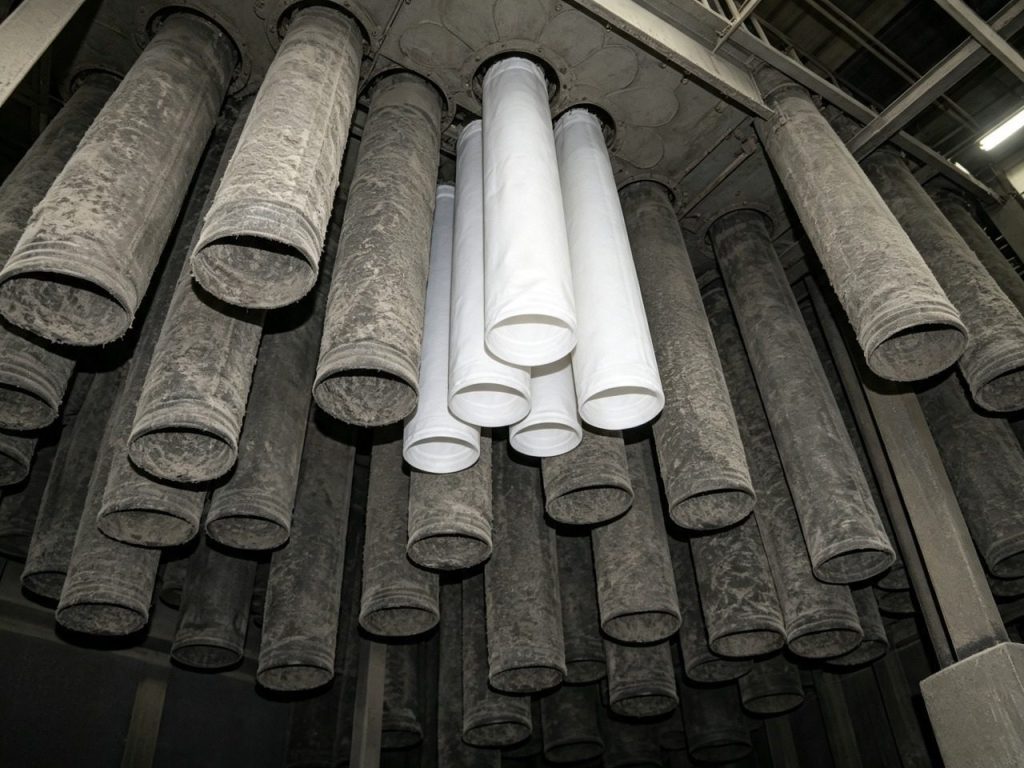
Inside a baghouse, every bag shares the same fan and the same airflow path. The bags do not operate independently — they behave like parallel branches of one flow network. A new bag has very low resistance, while an aged bag has accumulated years of embedded fines that pulse cleaning cannot remove. Given the same pressure drop across the collector, the system naturally pushes more air through the low-resistance path: the new bags.
That extra airflow has real consequences. The new bags see higher filtration velocity, which means faster dust loading, more frequent cleaning cycles, and heavier abrasion at the media surface. They end up doing more of the work than the rest of the set, wear unevenly, and fail much sooner than the five or six years the original set delivered. The replacement becomes a recurring cost instead of a one-time fix.
Think of it as a parallel piping network rather than a set of independent filters: open a low-resistance branch and the flow redistributes toward it. The mechanism is the same inside a collector, just harder to see.
Read the signals: differential pressure and emissions trends
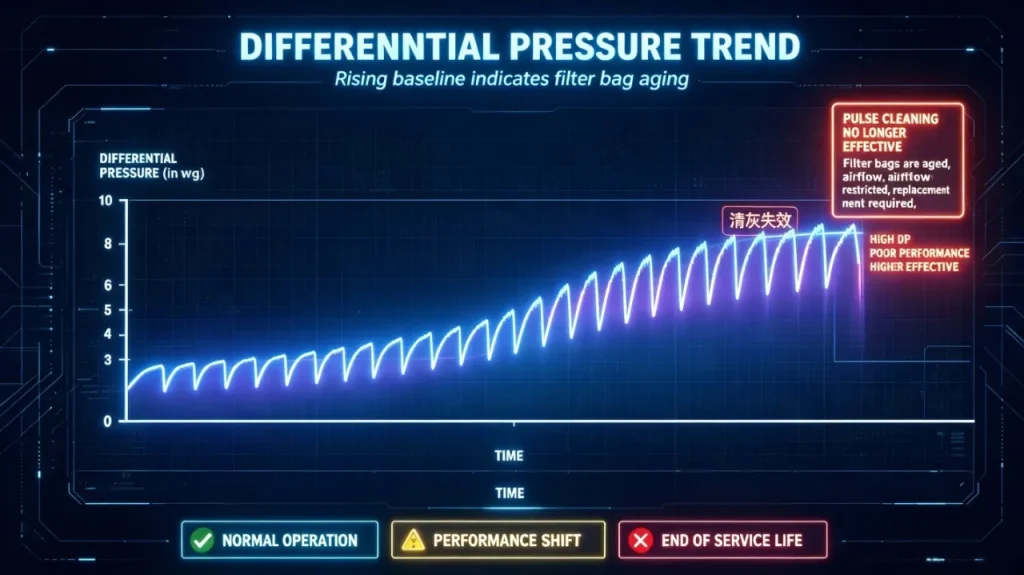
The easiest way to judge whether a full changeout is approaching is to track the differential pressure trend over time. When the pressure drop has climbed steadily over several years and pulse cleaning no longer brings it back down, the media is likely loaded with embedded fines — the set has aged as a group. The same logic applies to emissions: if outlet dust readings rise without visible holes in the bags, the media itself may have reached the end of its service life.
These are the situations where replacing only the visibly damaged bags will not restore collector performance. The rest of the set is still restricting airflow, and the differential pressure stays high no matter how many new bags are installed.
The hidden cost of repeated spot changes
Comparing the price of ten bags against the price of six hundred misses most of the real cost. Every changeout means labor, downtime, and lost production. A plant that replaces ten bags this month and twenty next month may spend more on repeated shutdowns and crew mobilization than one planned changeout during the annual outage — and it never gets a clean performance reset.
Facilities that schedule complete filter replacements during planned shutdowns do so for a reason: one interruption, one labor mobilization, and a collector that returns to design airflow. When maintenance labor, production loss, and the cost of repeat failures are added up, the “cheap” option is frequently the expensive one.
Don’t forget the cages
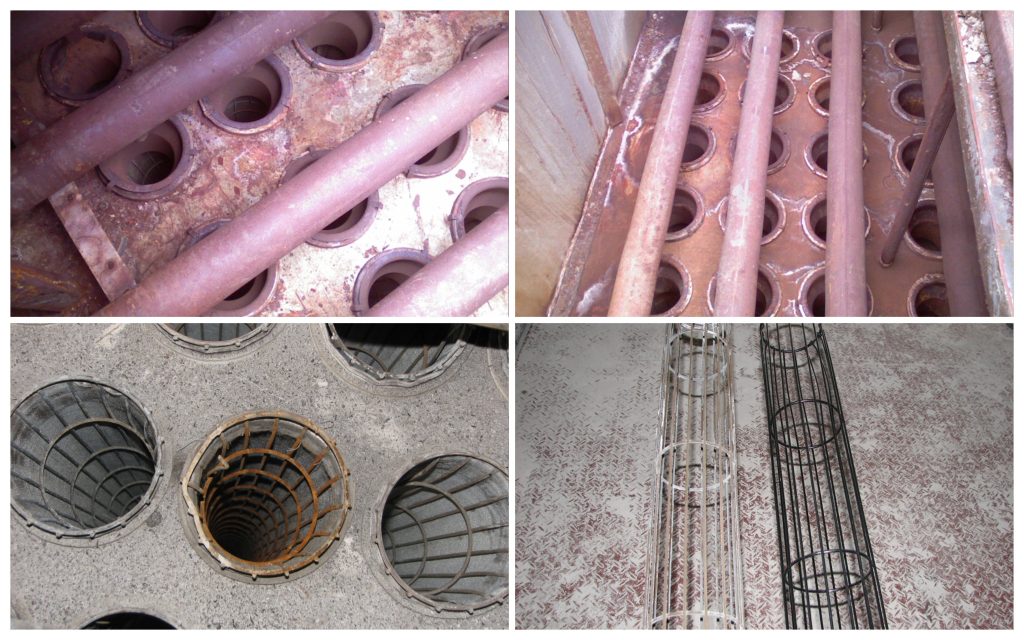
Whenever bags are replaced, the filter cages deserve equal attention. Rust, broken welds, bent wires, worn venturis, and sharp edges will damage brand-new bags quickly. One of the most common field mistakes is installing fresh bags over cages that have already reached the end of their own service life. If a cage is questionable, replacing the bag and cage together is usually the better long-term investment — a damaged cage can destroy a new bag in a fraction of its expected life.
A five-step decision checklist
Use this sequence the next time a bag failure appears:
- Identify the failure mode. Inspect the failed bags: tear, hole, chemical damage, or blinding?
- Find the cause. Was there a specific event (spark, cage failure, installation error) or no obvious trigger?
- Check the set’s age and condition. How old are the remaining bags, and has differential pressure been rising steadily?
- Quantify the share. Are the failed bags under 5% of the total? Above that, plan a staged or full changeout.
- Inspect the cages. If cages are marginal, budget for them in the same changeout.
A full inspection costs a fraction of an unnecessary changeout — and it is the only way to know whether you are solving a leak or postponing a problem.
Yuanchen Technology has manufactured filter bags since 2006, is listed on the Shanghai Stock Exchange’s STAR Market, and holds national “specialized and innovative little giant” enterprise status. Our engineers work with steel, cement, power, chemical, and waste-to-energy plants across the world. If you are unsure whether your collector needs a spot change or a full changeout, send us your operating data for a free replacement assessment.