
Condensation does not announce itself. It works in the background for weeks — damp filter media, a slow pressure-drop climb, dust caking on hopper walls — until one morning the differential pressure spikes and the line goes down. By then the damage is usually measured in thousands of dollars of replacement filter bags plus hours of lost production.
Most maintenance teams treat condensation as a humidity problem and respond with more housekeeping. That treats the symptom. Condensation is an engineering problem: the gas hits a surface colder than its dew point, and water drops out of suspension. Fix the temperature at the right points and the moisture stops forming on its own.
This guide covers the design-side controls that stop condensation before it starts — with a cost model so you can justify the fix to whoever signs the purchase order.
Why Condensation Forms: It Is a Temperature Problem, Not a Humidity Problem
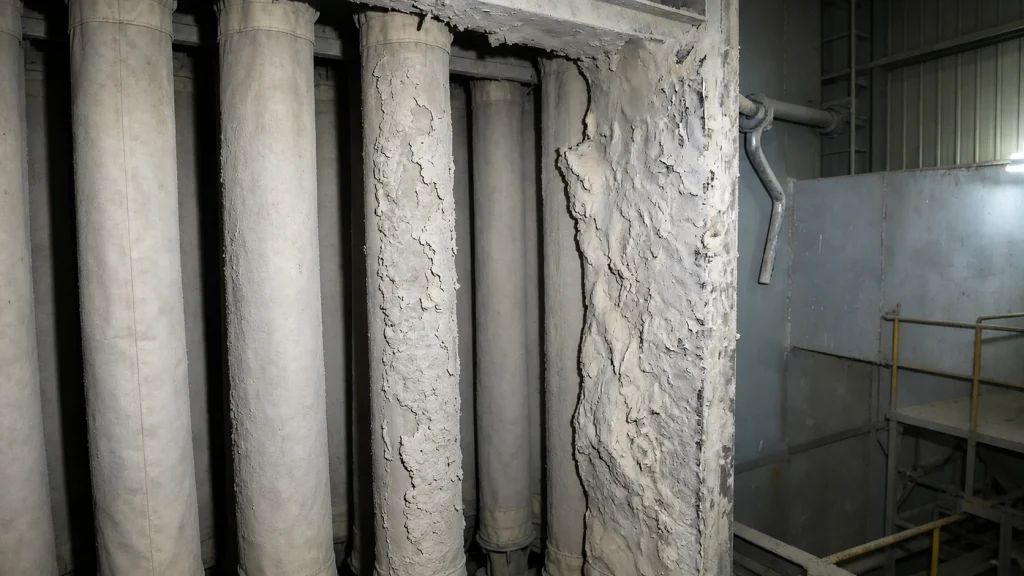
The dew point is the temperature at which water vapor in the gas starts to condense into liquid. Warm process air can carry a surprising amount of water vapor without causing trouble. The instant that air cools below its dew point, that suspended moisture turns into droplets on filter bags, hopper walls, ductwork, and manifold interiors.
The trigger is almost never “too much humidity.” It is a temperature drop that pushes the gas past its dew point. That is why condensation clusters around startup, shutdown, cold weather, overnight cooling, and any point where outdoor air leaks into the system.
A useful rule of thumb for baghouse operation: keep gas temperature at least 15°C (27°F) above the dew point. When the process runs close to the dew point, even a small temperature swing — a cold night, a batch change, a leak — crosses the line and starts depositing water.
Field test (no instruments needed): collect dust from the baghouse wall, wrap it in a tissue, and squeeze. If the tissue shows moisture or an oily residue, you have condensation or oil carryover that needs investigation.
Design Fix #1 — Insulate, and Know Where the Cold Spots Are
The most common mistake is insulating the wrong thing or not enough. Cold surfaces are the problem, not the air volume. Prioritize insulation in this order:
- Hopper walls — collected dust falls onto the hopper’s cold inner surface before discharge. This is the first place bridge formation starts. Insulation here is cheap and has the highest payoff.
- Ductwork between the process and the baghouse — long, uninsulated runs in cold climates let process air cool below the dew point before it even reaches the filter.
- The baghouse housing itself — for installations outdoors or in unheated buildings.
Where insulation alone cannot hold temperature — process air entering near ambient temperature with high moisture load — add an inlet process air heater upstream of the baghouse. Heaters can be electric, natural gas, steam, thermal-oil, or indirect-fired heat exchangers. In cold climates, some facilities add make-up air heaters to preheat ventilation air before it enters the process.
The engineering fix is cheaper than most people think. Sometimes simply moving the baghouse closer to the process or insulating one duct run removes years of moisture problems.
Design Fix #2 — Kill Air Leaks First, Then Add Heat
Before spending on heaters, fix the leaks. Outdoor air entering through worn door seals, leaking access panels, damaged expansion joints, cracked welds, or aged ducting does double damage: it brings in cold, humid air, and it makes the fan pull from the leak instead of from the process gas it is meant to clean.
A small leak undermines the whole system. Every cubic meter of cold outside air pulled in through a leak is a cubic meter of process gas not being filtered. Inspect access doors, gaskets, expansion joints, inspection covers, and pipe runs. This is the lowest-cost fix in the entire list — and the one most often skipped.
Design Fix #3 — Keep Compressed Air Dry
Pulse-jet baghouses clean filters with compressed air. If that air carries moisture, every cleaning pulse sprays water directly onto the clean side of the filter media — the side that must stay dry to shed dust.
Check the compressed air dryer, oil-water separators, drain valves, and filters regularly. Systems with auto-purge valves or inline air filters remove water before it reaches the pulse valves, improving cleaning efficiency and protecting the media.
Design Fix #4 — Get the Hopper Right
Hopper dust that does not discharge becomes a maintenance disaster. When condensation forms on hopper walls, dust cakes, bridges, and stops flowing. Once a bridge forms, material backs up into the baghouse, raises system resistance, and triggers a cascade of operating problems.
Keep rotary airlocks, screw conveyors, vibrators, and aeration devices running so collected material discharges continuously. In demanding environments, add hopper heaters or heat tracing to hold wall temperature above the dew point — the exact location where condensation forms first.
The Cost Model: What One Condensation Event Really Costs You
Condensation damage is expensive precisely because it is invisible until it is severe. Build your own estimate with three variables:
- Replacement filter bags. Premature filter changeout is the largest single cost. If condensation shortens media life from the expected 3–4 years to 2, you are buying replacements 30–50% more often. On a 500-bag unit, that is a five-figure swing in media cost alone.
- Downtime and lost production. Every hour the line is down to swap bags or clear a bridged hopper is an hour of lost throughput. For a continuous process, the downtime cost frequently exceeds the media cost. Run the number on your own hourly production value — it usually settles the argument.
- Energy and corrosion. High differential pressure makes the fan work harder, raising power consumption. Corrosion on internal parts — from acid compounds combining with moisture in the gas — shortens equipment life and invites unplanned repair shutdowns.
The pattern is easy to underestimate because each cost is spread across months. But together they justify most condensation-prevention upgrades within a single filter-change cycle. If you are already replacing bags early, the engineering fix usually pays for itself.
Startup and Shutdown Discipline
Condensation forms most readily during the cooling phase after shutdown, when temperature drifts below the dew point and moisture settles into the housing until the next start. Simple operating rules cut this risk:
- Keep the fan running 20–30 minutes after production stops, to purge warm, humid air.
- Shut off water sprays before shutdown so residual moisture has time to evaporate.
- Avoid sudden temperature drops.
- On startup, let the process temperature stabilize before exposing the baghouse to a high-humidity load.
These matter most in cold climates where overnight temperature swings are large.
Choosing Filter Media for Humid Service
Not every baghouse needs exotic media — but humid, corrosive, or condensation-prone service does. Standard polyester bags work well in many applications. For wet environments or frequent condensation, consider media that stays effective when moisture is present:
- Oil- and water-repellent (oleophobic/hydrophobic) treated media — resists dust caking in damp conditions
- PTFE membrane filters — tight surface filtration, excellent for sticky or moist dust
- PTFE felt — chemical resistance for corrosive gas streams
- Acrylic media — good for acidic, humid flue gas
- Other chemically resistant materials
The right choice depends on more than humidity: temperature, chemical exposure, and the dust itself all matter. When moisture combines with acid or alkaline compounds in the gas, some synthetic media degrade far faster than expected. For process gases above ~160°C with moisture and aggressive chemistry, PPS or PTFE-based media are typically the engineering answer; for cool, humid, acidic streams, acrylic or treated polyester is often the sensible default.
Monitor Before the Problem Becomes a Failure
Routine checks should cover:
- Differential pressure trends — an unexpected climb is your earliest warning
- Visual inspection inside the housing for rust or standing water
- Hopper discharge performance
- Rotary airlock operation
- Door seal condition
- Compressed air quality
- Duct leaks
If differential pressure starts climbing unexpectedly, rust appears inside, or dust sticks to internal surfaces, investigate immediately. A small moisture problem caught early is a weekend fix; the same problem ignored is a filter changeout and a production stop.
Bottom Line
Preventing condensation is not more housekeeping. It is holding process temperature above the dew point, sealing air leaks, keeping compressed air dry, selecting media that tolerates humidity, and following disciplined startup and shutdown. When those design-side measures are combined with routine monitoring, a baghouse runs more reliably, needs less maintenance, and delivers years of service instead of an expensive surprise.
If you are seeing early filter changeouts or pressure-drop creep, send us your operating temperature, gas composition, and current media spec. We will check your dew-point margin and recommend the filter bag — and where needed, the insulation or heating — that fits your actual duty.