
Why Ordinary Filter Bags Fail in Extreme Chemical Duress
In our engineering practice across waste incineration and cement kilns, we often see standard filter bags fail prematurely. Chemical attack and thermal degradation are the primary culprits behind these unexpected shutdowns.
When flue gas contains high concentrations of NOx, NOx, or moisture, materials like polyester or aramid degrade rapidly through hydrolysis. This structural failure leads to costly unscheduled maintenance and emission spikes.
Deploying a PTFE Bag: High-Temperature and Corrosion-Resistant Industrial Filtration Solution changes the operational dynamic completely. It provides the necessary defense against chemical attack and extreme temperatures.
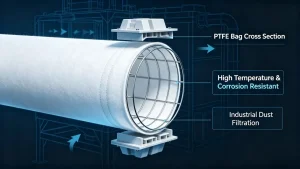
The Science Behind 100% PTFE Bag Filtration Performance
PTFE (Polytetrafluoroethylene) features a carbon-fluorine bond structure that provides exceptional chemical inertness. It resists damage from strong acids, alkalis, and powerful oxidizing agents.
In asphalt mixing plants and chemical processing lines, these bags handle continuous operating temperatures up to 260°C (500°F). They also tolerate structural surges up to 280°C without losing structural integrity.
Surface filtration dynamics prevent fine particulate matter from embedding deep within the felt substrate. This specific mechanism ensures stable differential pressure and simplifies pulse-jet cleaning cycles.
Key Technical Specifications & Operating Parameters
- Continuous Operating Temperature: Up to 260°C (500°F)
- Max Surge Limit: 280°C (536°F)
- Chemical Resistance: pH range 1–14 (Excellent resistance to acids, alkalis, and oxidizers)
- Hydrolysis Resistance: Immune to moisture-driven fabric degradation
Field Engineering Insights: Avoiding Premature Bag Failures
Selecting the right fiber is only part of the solution. Our field diagnostics reveal that real-world reliability depends heavily on bag construction and cage matching.
- Thread Selection Matters: Standard sewing threads can dissolve in acidic flue gas. Always specify 100% PTFE sewing thread to ensure the seams last as long as the filter body.
- Cage Match and Fit: PTFE felt lacks high elasticity. Ensure the support cages have at least 20 vertical wires to minimize flexing stress and prevent mechanical wear during pulse-jet cleaning.
- Managing the Air-to-Cloth Ratio: For heavy dust loading in chemical applications, keep the filtration velocity below 0.8 m/min. This setting lowers the pressure drop and extends overall service life.
How Does Your Current Filtration System Compare?
If you are experiencing high pressure drops or replacing filter bags every few months, your current media might not suit your operational environment. Upgrading to a PTFE Bag: High-Temperature and Corrosion-Resistant Industrial Filtration Solution can help stabilize your emissions and reduce maintenance costs.